A Moroccan pastry class in Tangier is a hands-on culinary experience where guests prepare traditional Oriental sweets from scratch alongside a local pastry chef learning the techniques, ingredients, and cultural stories behind each recipe before tasting everything on a rooftop terrace above the medina.
Morocco does not do sweets halfway. Walk into any home, any celebration, any Friday afternoon gathering in the country, and you will find a tray of hand-made pastries at the center of the table. Baklawa glistening with honey. Ghriba cookies still warm from the oven. Little cups of spiced custard crowned with crushed almonds. Sweets are not dessert in Morocco. They are the opening act the first gesture of hospitality before anything else is said or offered.
Halawiyat Arabia, the Moroccan pastry class at Riad Sultana in the heart of the Tangier medina, is built around this tradition. In 2.5 to 3 hours, you learn to make four of these pastries yourself. Not from a packet. Not from a demonstration you watch from a distance. By hand, from raw ingredients, guided at every step by a local pastry chef who has been making these recipes her entire life.
This guide covers what the experience involves, what you make, where it takes place, and who it suits.
The Tradition Behind Moroccan Pastry
Moroccan pastry-making is one of the oldest living culinary traditions in North Africa, drawing simultaneously from Berber, Arab, Andalusian, and Ottoman influences each of which left a distinct recipe in the national repertoire. Baklawa arrived through Ottoman influence via the eastern Maghreb. Ghriba has Berber roots and exists in dozens of regional variations across the country. Orange and coconut cake reflects the Andalusian fondness for citrus. Honey pastry cups draw on Arab sweet-making technique and the Moroccan tradition of gifting sweets at weddings and religious holidays.
What these recipes share is a reliance on technique over complexity. The ingredients are simple: almonds, honey, semolina, butter, orange blossom water, orange zest, filo pastry, eggs. What makes the difference is how you handle them the temperature of the butter, the tightness of the filo fold, the timing of the honey glaze. These are things you learn by doing, not by reading.
A Moroccan pastry class gives you that doing. By the end of 2.5 hours at Riad Sultana, you will have folded baklawa triangles, filled honey cups by hand, shaped ghriba cookies, and removed your own orange cake from the oven. You will also understand, in a way that no restaurant meal can teach, why these sweets matter so much in Moroccan culture.
What You Make in the Halawiyat Arabia Class
The Halawiyat Arabia pastry class covers four traditional recipes in a single session each chosen to represent a different technique and a different chapter of Moroccan pastry history.
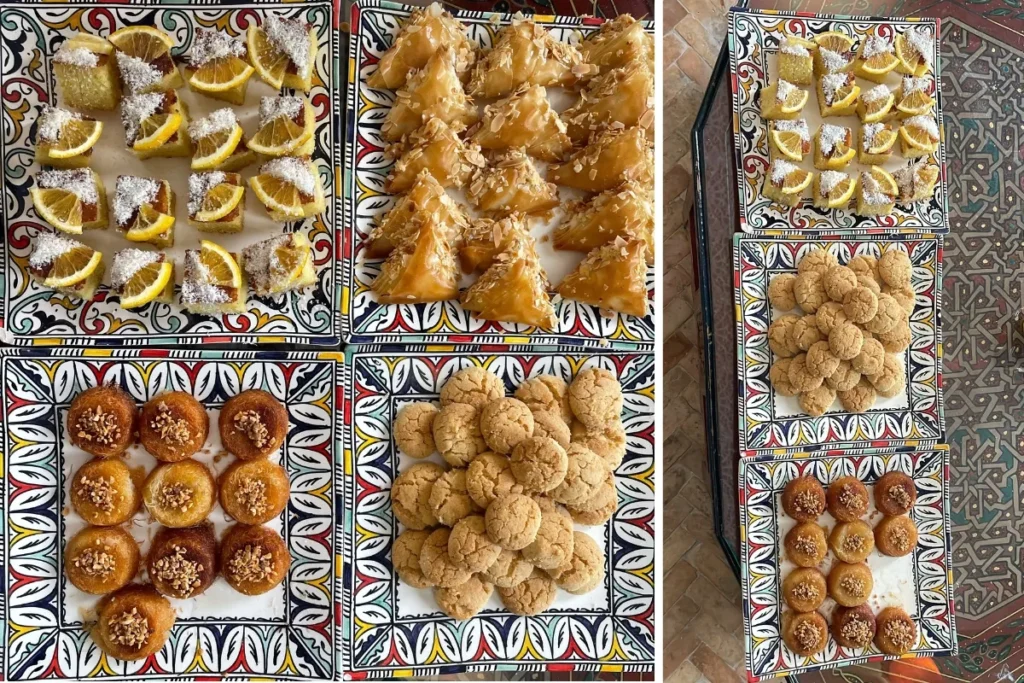
The class begins with baklawa. You work with filo pastry sheets, layer them with a spiced almond filling, cut them into triangles, and glaze them with honey. The technique is precise. The filo tears easily if handled without care, and the honey must go on at the right moment. Getting it right is satisfying in a way that is difficult to describe before you have done it.
Next, honey pastry cups. You press a buttery semolina dough into a muffin tray, fill each one by hand, and top them with crushed nuts before baking. They come out golden, sticky, and fragrant.
Ghriba cookies follow. These are Morocco’s equivalent of a shortbread dense, slightly cracked on the surface, made from almond meal and semolina. The texture depends entirely on the ratio of ingredients and how long you work the dough. The chef explains what to look for at each stage.
The final recipe is an orange and coconut cake, sliced into small squares and finished with orange rounds and a dusting of coconut. Light, aromatic, and immediately recognizable as North African in character.
All four pastries are made in the same 2.5 to 3-hour session. All four are eaten together on the rooftop terrace at the end, with fresh mint tea poured from a silver pot.
Where It Takes Place – Riad Sultana, Tangier Medina
Riad Sultana sits inside the old medina of Tangier the walled historic quarter that climbs the hill above the port and the Kasbah. The riad itself is a traditional Moroccan house: tiled floors, carved plasterwork, a central courtyard open to the sky, and a rooftop terrace that looks out over the white rooftops of the medina, the sea beyond, and on a clear day, the coast of Spain across the Strait of Gibraltar.
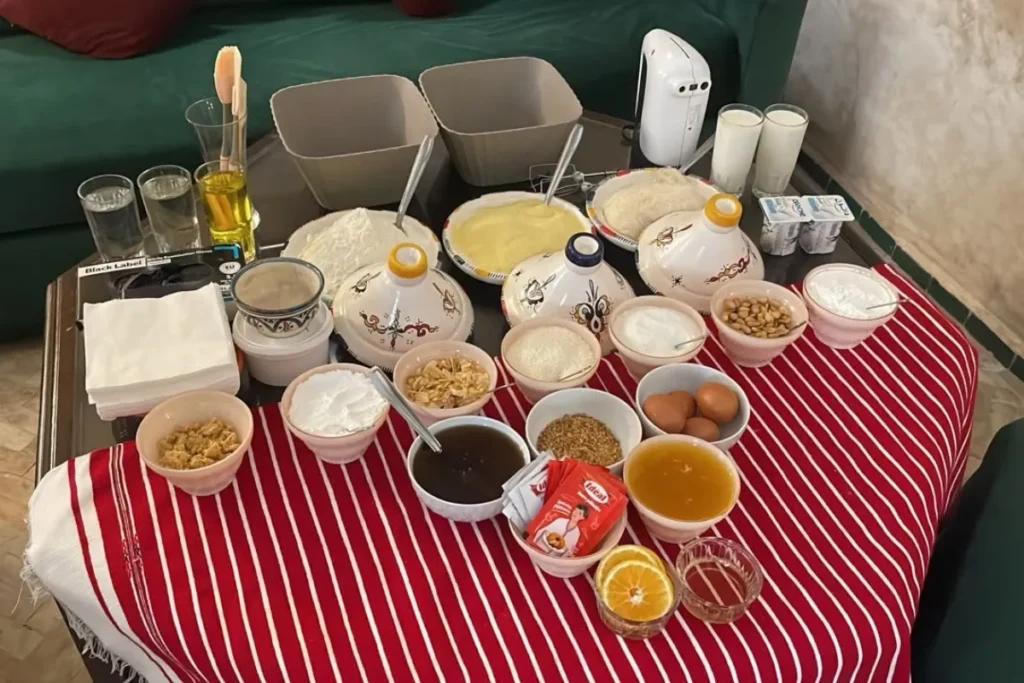
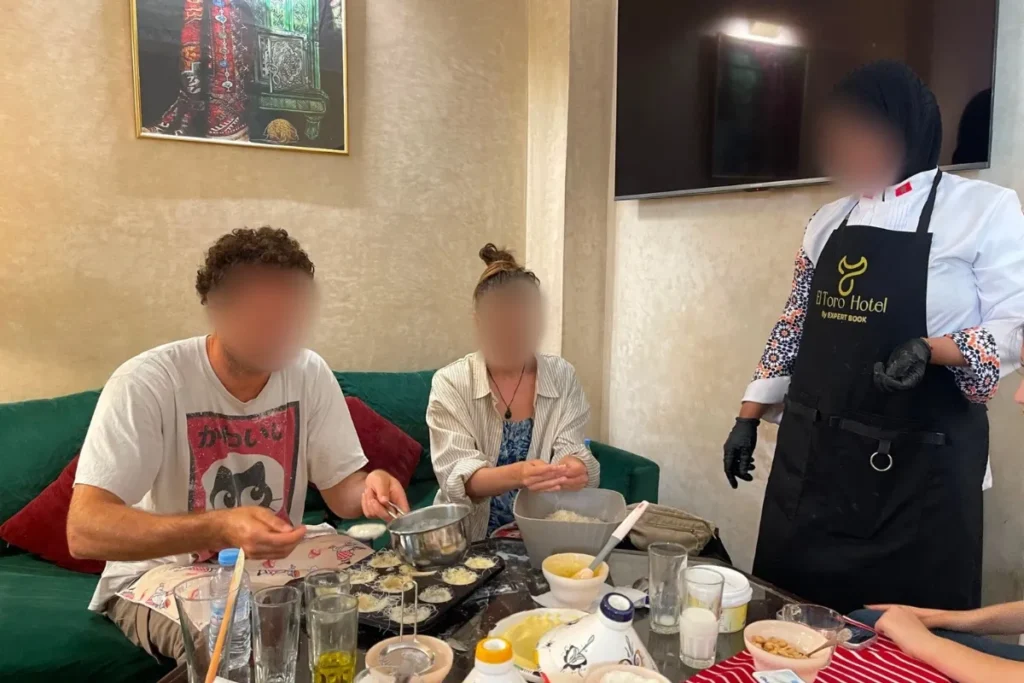
The pastry class takes place in the salon on the ground floor. The space is intimate: cushioned benches, low tables covered with red-striped cloth, and every surface laid out with the equipment and ingredients for the session before guests arrive. It is designed for small groups. The chef works directly with you, not in front of you.
After the class, the tasting moves to the rooftop. The four pastries you made are arranged on Moroccan ceramic plates. Mint tea is poured. The city is visible in every direction. It is a good place to eat what you just spent two hours making.
Location and Access
Riad Sultana is located in the Tangier medina, a 10 to 15-minute walk from the Grand Socco. Guests arriving from the Tangier cruise terminal or city centre hotels can reach it by taxi in under 10 minutes. Pick it Cook it can arrange transfer on request mention your starting point at the time of booking.
Who This Moroccan Pastry Class Is For
The Halawiyat Arabia class suits a wide range of travelers, but it draws most naturally to a specific kind of visitor: someone who wants more than sightseeing, someone who leaves a place wanting to be able to reproduce something they experienced there.
No baking experience is required. The chef adjusts her pace to the group and explains every step before it begins. The session moves at a comfortable rhythm there is enough to do to stay engaged throughout, and enough downtime between steps to ask questions, take photos, and talk.
It is well-suited to couples looking for a shared activity that is more meaningful than a restaurant meal. It works for solo travelers who want to connect with a place through doing something together. It is appropriate for small groups of friends. Travel agencies and tour operators also include it as a cultural half-day in Tangier itineraries.
The minimum group size is 2 people. The class can be booked privately for any size of group.
What to Expect – Step by Step
- Arrival and welcome drink at Riad Sultana
- Introduction to Moroccan pastry culture and the four recipes of the session
- Baklawa preparation: filo layering, almond filling, cutting and honey glaze
- Honey pastry cup preparation: dough pressing, filling, nut topping
- Ghriba cookie shaping and baking
- Orange and coconut cake preparation
- Baking and finishing session with the chef
- Tasting on the rooftop terrace with fresh mint tea
- Certificate of Participation and recipe cards to take home
Total duration: approximately 2.5 to 3 hours from welcome to farewell.
Who Teaches the Class
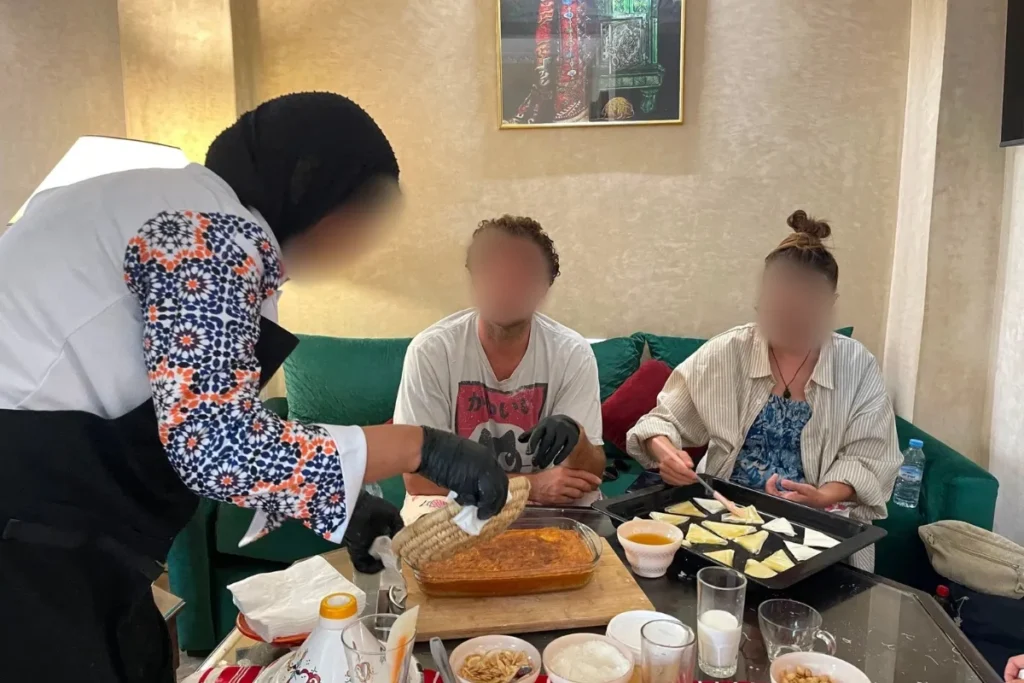
The Halawiyat Arabia class is led by a local pastry chef based in Tangier who has been preparing traditional Moroccan and Oriental sweets for over a decade. She teaches the class in French and Arabic, with translation available in English. Her approach is patient and hands-on: she demonstrates once, then works alongside guests through each step rather than watching from a distance.
Pick it Cook it has been running culinary experiences in Tangier since 2024. All classes are private meaning guests share the space only with their own group, not with strangers. Every participant receives a Pick it Cook it Certificate of Participation at the end of the session.
Frequently Asked Questions
How long does the Halawiyat Arabia pastry class last?
The class lasts approximately 2.5 to 3 hours, including preparation, baking, tasting on the rooftop, and the certificate presentation.
What pastries do we make?
You prepare four traditional recipes by hand: baklawa triangles with honey and almonds, honey pastry cups with crushed nuts, ghriba almond cookies, and an orange and coconut cake.
Is this suitable for complete beginners?
Yes. No baking experience is needed. The chef guides every step at a pace that works for the group, and the recipes are chosen because they are learnable in a single session.
What is included in the price?
The class includes all ingredients, aprons, hands-on preparation of all four pastries, a full tasting with fresh mint tea on the rooftop terrace, a Pick it Cook it Certificate of Participation, and printed recipe cards to take home.
Where exactly does the class take place?
The class takes place at Riad Sultana in the Tangier medina. Transfer from your hotel, riad, or the cruise terminal can be arranged on request.
Can dietary requirements be accommodated?
Yes. Please communicate any allergies or dietary restrictions at the time of booking and the team will adapt accordingly.
Book Your Moroccan Pastry Class in Tangier
Moroccan pastry is not complicated to learn. It is precise. The techniques that make baklawa crisp rather than soggy, or ghriba dense rather than crumbly, are things a good teacher can pass on in an afternoon. What stays with you afterward is not just the recipe it is the understanding of why these sweets exist, what they mean in a Moroccan household, and what it feels like to make them yourself on a rooftop in the Tangier medina.
The Halawiyat Arabia class runs at Riad Sultana in the heart of the Tangier medina. Sessions are private, last 2.5 to 3 hours, and are open to groups of 2 or more. Book directly at pickitcookit.com or via WhatsApp: https://wa.me/212662735863