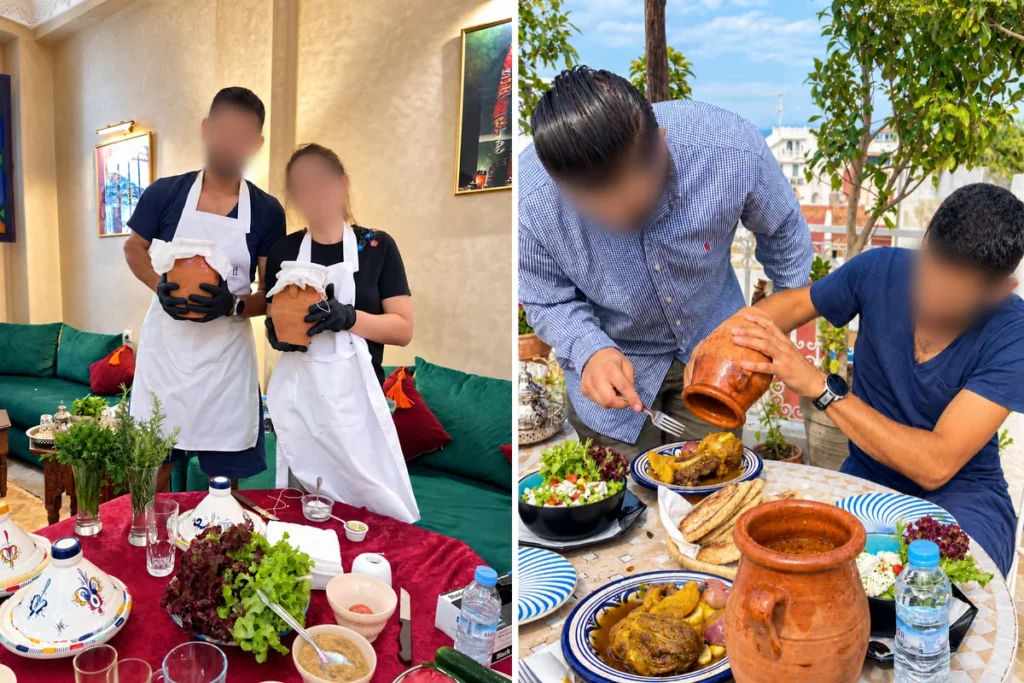
The tanjia cooking class in Tangier is a hands-on culinary experience at Riad Sultana where guests prepare a slow-cooked lamb dish sealed inside a traditional clay amphora with saffron, preserved lemon, smen, and ras el hanout, then share the feast on a rooftop terrace overlooking the Tangier medina.
There are very few dishes in Morocco that carry as much history as the tanjia. It is not just food. It is a record of how men in Marrakech once cooked. They would leave their sealed clay pots at the furnace of the public hammam before Friday prayers and return hours later to a meal that had slow-cooked itself in the residual heat of the bath house fire. No kitchen. No supervision. Just patience, fire, and lamb melting from the bone in a golden saffron sauce.
At Pick it Cook it, this tradition comes to life at Riad Sultana in the Tangier medina. In a 3 to 4-hour private session, you build the tanjia from scratch: blending spices, packing the amphora by hand, preparing fresh salads and khobz bread alongside it, then eating everything you made on a terrace above the city.
This guide explains the history, the process, the setting, and who the class suits.
What Is a Tanjia and Why Does It Matter
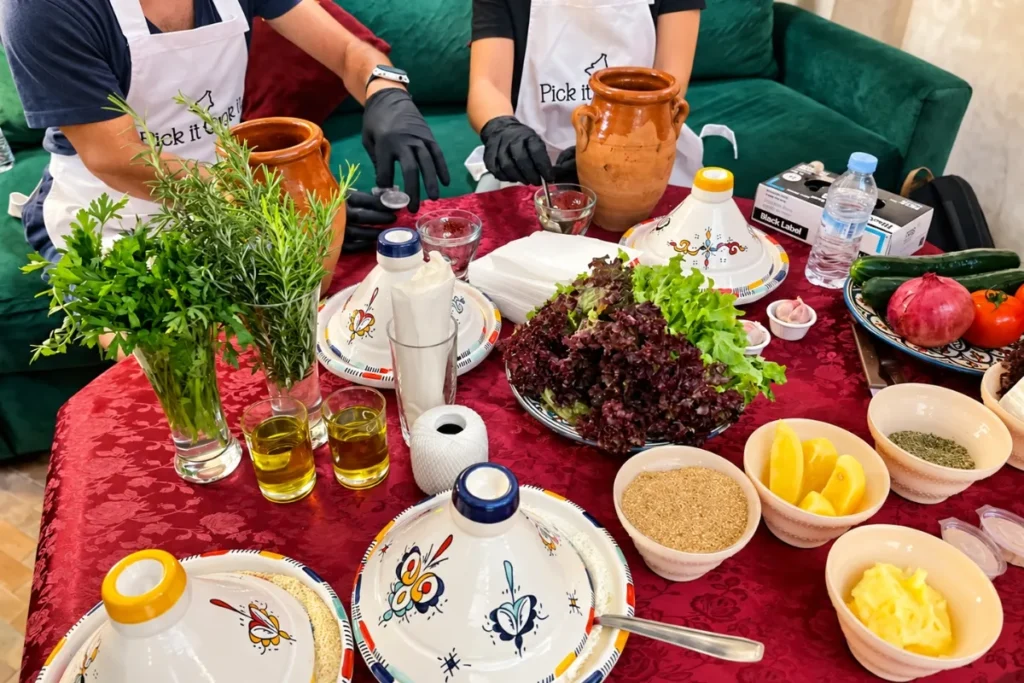
The tanjia is simultaneously the name of the clay vessel and the dish cooked inside it. The vessel is a round-bellied terra cotta amphora with two small handles and a narrow mouth. Wide enough to pack ingredients, narrow enough to seal tightly with cloth or foil and string. The dish is lamb, seasoned with a specific spice base, cooked slowly until the meat and bone separate completely.
The origin is working-class Marrakech. Men heading to the hammam on Friday mornings would pack their tanjia at home, carry it to the hammam furnace, hand it over to the furnace keeper, and collect it hours later. The dish cooked in the heat of the bath house fire while they went about their day. No one watched it. No one adjusted it. When they opened it, it was ready.
What makes the tanjia technically distinct from a tagine is the absence of added liquid. The meat releases its own fat and juices as it cooks. Combined with the smen (aged clarified butter), preserved lemon, and saffron, these natural juices create a deep, golden, intensely flavoured sauce entirely from within the sealed vessel. There is nothing to stir and nothing to check. The amphora does the work.
Few cooking experiences outside of Marrakech teach this dish properly. The Tanjia Marrakchia class at Riad Sultana in Tangier is one of them.
What You Prepare in the Tanjia Class
The session begins with the spice base. You measure and mix ras el hanout, ground cumin, saffron threads, salt, and black pepper into a paste with olive oil. The chef shows you the ratios and explains what each spice does to the lamb during the long cook. This is not a shortcut blend from a packet. You build it from individual components, the way it is done in Moroccan households.
From there, the lamb goes in. You season it by hand, turning each piece to coat it fully in the spice paste before packing it into the amphora. Preserved lemon quarters go in next, halved and tucked alongside the meat. Then smen, the aged clarified butter that gives the tanjia its characteristic richness. The amphora is then sealed. The meat needs nothing added it creates its own sauce from its own fat and the preserved lemon as it cooks.
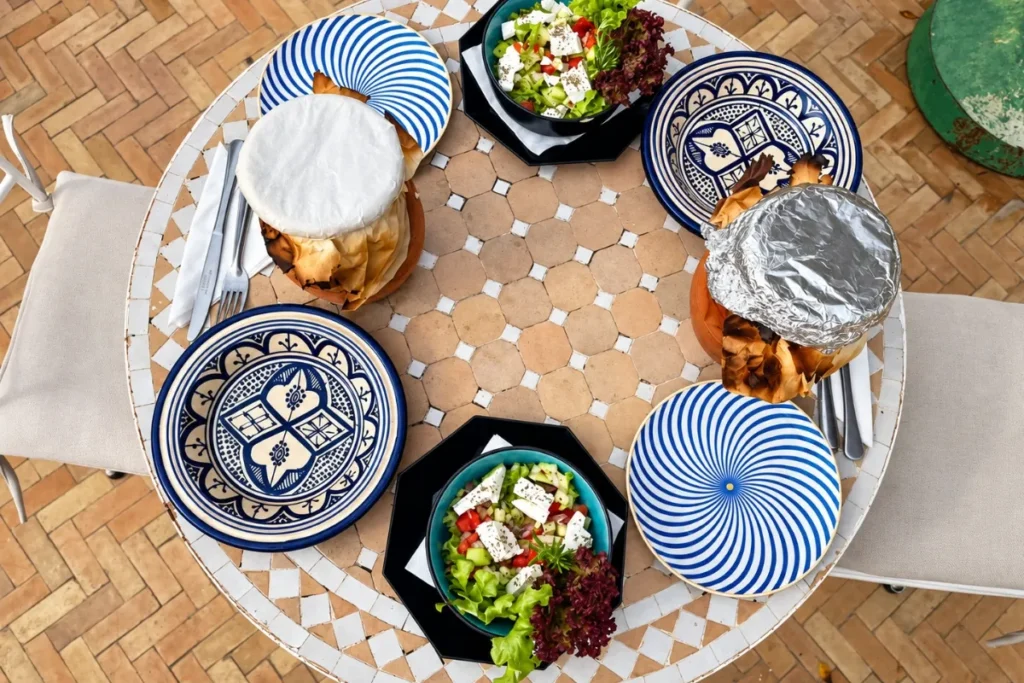
The sealing is a small ritual in itself. You stretch a round of natural cloth or foil over the mouth of the amphora, tie it tight with string, and that is that. The tanjia is now sealed and cooking.
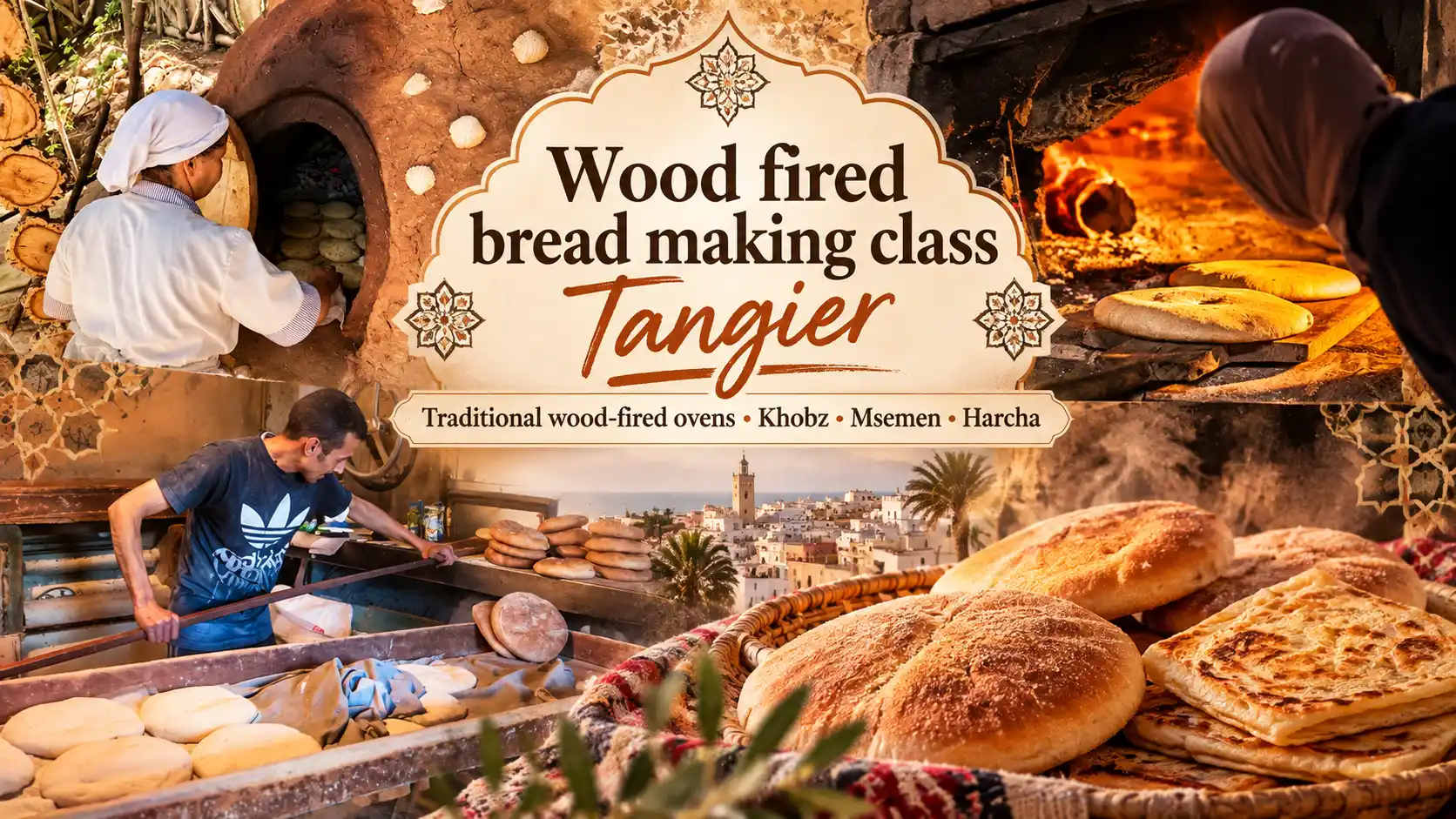
While it cooks, you prepare two accompaniments. First, fresh Moroccan salads: chopped tomato, cucumber, onion, and green herbs in a simple olive oil and lemon dressing. Then khobz bread, which you shape by hand and bake until it comes out golden, with a crust that sounds hollow when you tap it.
When the amphora is opened at the table, the smell arrives before anything else. Then the sight of the sauce, reduced and golden, pooling around lamb that no longer needs a knife.
The Setting: Riad Sultana, Tangier Medina
Riad Sultana is a traditional Moroccan townhouse set inside the old medina of Tangier. The building follows the classic riad layout: thick walls facing the street, interior rooms arranged around a central courtyard, and a rooftop terrace open to the sky. From the terrace, the view takes in the white rooftops of the medina, bougainvillea spilling over terracotta walls, and the sea visible beyond the city in the direction of the Strait of Gibraltar.
The tanjia class takes place in the salon on the ground floor. The room is furnished with deep green velvet seating and low tables covered with red-striped cloth, every surface laid out with ingredients and equipment before guests arrive. It is an indoor space, cool in summer and warm in winter, and it fits small groups well. The chef works alongside you, not behind a counter.
The meal at the end moves to the rooftop. The mosaic tables are set with hand-painted Moroccan ceramic plates, a basket of khobz bread, the salad bowls you prepared, and the tanjia amphoras still warm from cooking. Mint tea is poured. The view is clear in every direction.
Location and How to Get There
Riad Sultana is inside the Tangier medina, a 10-minute walk from the Grand Socco. From the Tangier cruise terminal or city centre hotels, a taxi takes under 10 minutes. Pick it Cook it can arrange transfer from your hotel, riad, or the port on request. Mention where you are staying at the time of booking.
Who the Tanjia Class Is For
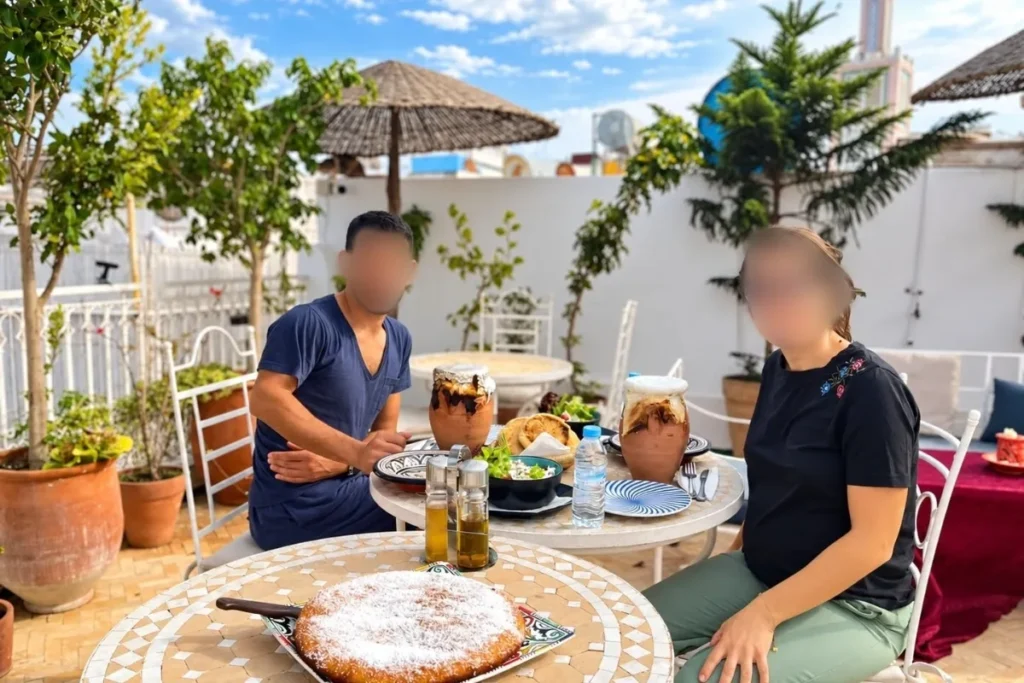
The tanjia class draws a specific kind of traveler. Not someone looking for a quick cooking demonstration, but someone who wants to understand a dish: its history, its logic, the reason it tastes the way it does, by making it from scratch.
No cooking experience is required. The technique is not complicated. You blend, pack, seal, and wait. What takes attention is the spice balance and the quality of the seal on the amphora. The chef explains both at the start and checks in throughout the preparation.
The session works well for couples who want a shared activity that goes deeper than a restaurant meal. It suits small groups of friends traveling together. Travel agencies and tour operators also include it as a cultural half-day in a Tangier itinerary, particularly for guests who have already done the medina walking tour and want something slower and more hands-on.
The minimum group size is 2 people. Private bookings are available for any size group.
What to Expect: Step by Step
- Arrival and welcome drink at Riad Sultana
- Introduction to the tanjia: its history, its origin in Marrakech, and how the cooking method works
- Spice base preparation: ras el hanout, cumin, saffron, salt, and black pepper blended by hand
- Lamb seasoning and amphora packing: meat, preserved lemon, and smen layered inside the clay vessel
- Sealing the tanjia: cloth or foil stretched over the mouth, tied with string
- Fresh salad preparation while the tanjia cooks
- Khobz bread preparation and baking
- Opening the tanjia at the table on the rooftop terrace
- Shared meal with mint tea and the recipes to take home
- Pick it Cook it Certificate of Participation
Total duration: approximately 3 to 4 hours from welcome to farewell.
About the Experience
The Tanjia Marrakchia class is led by a local chef based in Tangier with long experience in traditional Moroccan cooking. The class runs in the language your group is most comfortable with: French, Arabic, or English with translation. The chef’s approach is direct. She demonstrates once, explains why, then works alongside you rather than observing from a distance.
Pick it Cook it has been running culinary experiences in Tangier since 2024. All sessions are private: no strangers, no shared bookings, no group tours. The class is sized around your group. Every participant receives a Pick it Cook it Certificate of Participation at the end of the session.
Frequently Asked Questions
How long does the Tanjia Marrakchia class last?
The class lasts approximately 3 to 4 hours from arrival to the end of the rooftop meal, including spice preparation, packing the amphora, making salads and bread, and the shared feast with mint tea.
What exactly is a tanjia?
The tanjia is a traditional Moroccan clay amphora dish originating in Marrakech. Lamb is packed inside the sealed vessel with saffron, preserved lemon, smen, and spices, then slow-cooked. The result is meat that falls from the bone in a deep golden sauce. The word tanjia refers both to the clay vessel and the dish cooked inside it.
Do we prepare everything ourselves?
Yes. You build the spice base by hand, season and pack the lamb into the amphora yourself, seal it, and prepare the salads and khobz bread while the tanjia cooks. The chef guides every step.
What is included in the experience?
The class includes all ingredients (lamb, saffron, preserved lemon, smen, ras el hanout, cumin, fresh vegetables, bread flour), Pick it Cook it aprons, the full tanjia meal on the rooftop terrace with mint tea, a Certificate of Participation, and printed recipes to take home.
Is the class suitable for beginners?
Yes. The technique is straightforward and the chef adjusts the pace to the group. No prior cooking experience is needed.
Can dietary restrictions be accommodated?
Please communicate any allergies or dietary requirements at the time of booking. Lamb is the core ingredient of the tanjia. If you need an alternative, mention it when you book and the team will advise.
How is this different from a tagine class?
The tanjia cooks in a sealed clay amphora with no added liquid and no stirring. The meat creates its own sauce from within the sealed vessel. A tagine is cooked with a conical lid and typically uses a prepared broth. The technique, the result, and the history of the two dishes are entirely different.
Book the Tanjia Marrakchia Class in Tangier
The tanjia teaches patience in the most direct way possible. You seal the amphora and you wait. When it opens, the meat has done something that cannot be rushed. It has fallen apart in a sauce it built itself, from fat and saffron and preserved lemon and time. That is the lesson of the tanjia. It was never about the cook. It was always about the vessel, the fire, and the wait.
The Tanjia Marrakchia class runs at Riad Sultana in the heart of the Tangier medina. Sessions are private, last 3 to 4 hours, and are open to groups of 2 or more. Book directly at pickitcookit.com or via WhatsApp: https://wa.me/212662735863